Normandy Beaches Half-Day Afternoon Trip from Bayeux (A2)
Hotel pickupMax 8Air-conditioned minibus
From $109 per person
Euro prices are full adult admission.
| What to do | Cost | Open from October 2026 | Where |
|---|---|---|---|
| Bayeux Cathedral | Free | Daily 9am–6pm to 1 November, then 10am–6pm | Rue du Bienvenu |
| Battle of Normandy museum | €8.50 | Daily 10am–12:30pm, 2pm–6pm | Boulevard Fabian Ware |
| Bayeux War Cemetery | Free | Always open | Boulevard Fabian Ware |
| Reporters’ Memorial | Free | All year | Beside the cemetery |
| Art and history museum (MAHB) | €8.50, or €14 for both museums | Daily 10am–12:30pm, 2pm–6pm | 37 rue du Bienvenu |
| Old-town trail and the Aure path | Free | Any time | The old town, 2.5 km |
| Lace conservatory | Free | Monday to Saturday 9:30am–12:30pm, 2pm–5:30pm | 6 rue du Bienvenu |
| Weekly markets | Free to browse | Wednesday to 1:30pm, Saturday to 2pm | Rue Saint-Jean, place Saint-Patrice |
| Botanic garden | Free | 9am–7pm in October, 9am–5pm November to February | Route de Port-en-Bessin |
| Guided walk on the Tapestry | €10 | School holidays only, in French | Cathedral forecourt |
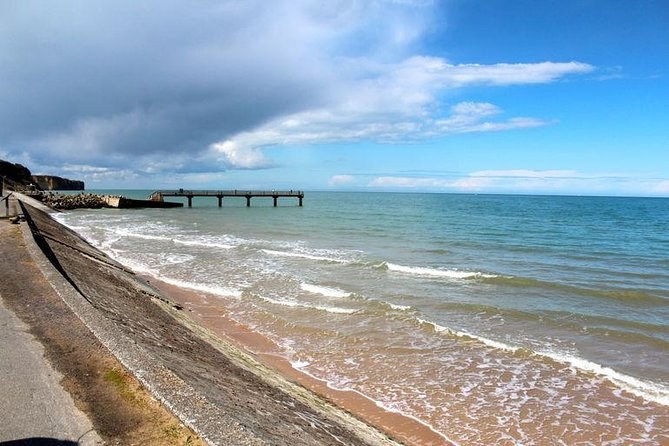
| Afternoon on the D-Day beaches | From $109 | 5 hours, back around 6pm | Hotel pickup |
| Day at the abbey in the bay | From $189 | 7 hours | Place du Québec |
Start here: it costs you nothing and opens daily, 9am to 6pm until 1 November and 10am to 6pm after. Sunday mass is at 11am. The building was consecrated on 14 July 1077 in front of William the Conqueror and his wife Matilda. The crypt, the western towers and the first level of the nave survive from that day.
The Memorial Museum of the Battle of Normandy covers the fighting from 7 June to 29 August 1944 in 2,300 square metres of galleries. You walk it in date order, past a diorama of the Falaise-Chambois Pocket and an archive film. Allow one to two hours. Admission is €8.50, and tickets are sold at the desk only. There is a lift, and a wheelchair you can borrow. From 1 October it shuts for lunch between 12:30pm and 2pm. Hours and admission along the rest of the coast are set out separately.
This is the largest Commonwealth cemetery of the Second World War in France. It holds 4,144 Commonwealth burials, 338 of them unidentified, and more than 500 graves of other nationalities, most of them German. Opposite, the Bayeux Memorial names more than 1,800 men with no known grave. The cemetery never closes and costs nothing. You cannot park in front of it, so leave your car at the museum, about 300 metres away.
On the same stretch, a landscaped walk runs between white steles naming more than 3,000 journalists killed at work since 1944. The town created it with Reporters Without Borders. It is free and open all year, and you can cover it, the museum and the cemetery on foot in one afternoon.
The Musée d’Art et d’Histoire Baron Gérard (MAHB) fills the former bishop’s palace at 37 rue du Bienvenu, beside the cathedral. Its 14 stages run in date order through 600 works of art, 1,000 pieces of Bayeux porcelain and lace, and 800 archaeological and ethnographic objects. Boudin, Caillebotte and Boucher are on the walls. You pay €8.50, or €14 for a pass that also covers the Battle of Normandy museum and stays valid for a year.
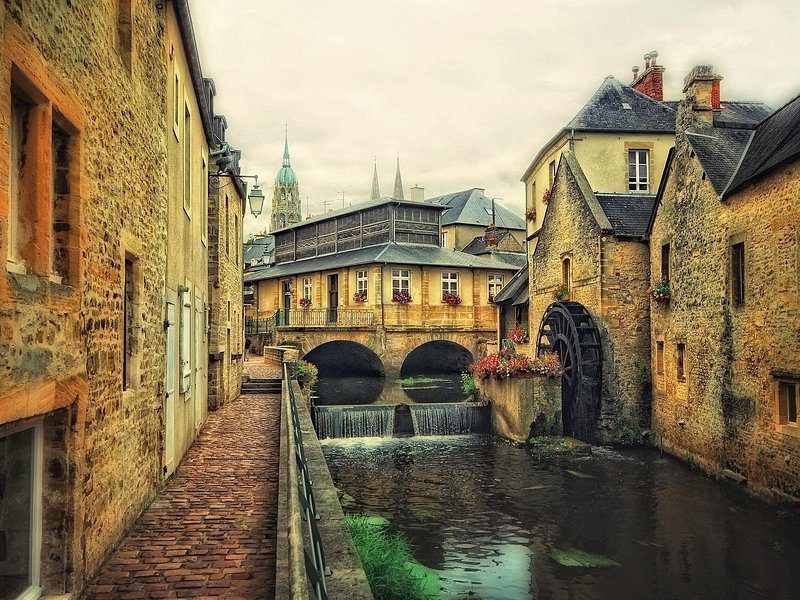
Bronze nails in the pavement mark a 2.5 km trail round the medieval town, with 23 information panels along it. From there, a 4 km footpath follows the river Aure through the old tanners’ and dyers’ quarter. The streets are intact because Bayeux was the first town in mainland France to be liberated, on 7 June 1944, with little fighting.
At the Conservatoire de la Dentelle, in the Maison d’Adam et Eve at 6 rue du Bienvenu, lace-makers demonstrate the work and answer your questions. The studio protects skills handed down from the town’s 17th-century lace-makers. Entry is free, and the doors stay shut on Sundays and bank holidays.
Wednesday’s market sets up along the pedestrian rue Saint-Jean from 7:30am to 1:30pm. Saturday’s takes over place Saint-Patrice from 7:30am to 2pm. Both bring local traders and producers, and the food page covers what to buy at a Normandy market.
The Jardin botanique, at 55 route de Port-en-Bessin, is free and holds 400 trees. The one to find is the weeping beech, a listed natural monument since 1932. You can walk in from 9am to 7pm in October and from 9am to 5pm between November and February.
The Bayeux Tapestry museum has been closed since 1 September 2025 and is due back in autumn 2027. The embroidery itself is at the British Museum in London from 10 September 2026 to 11 July 2027. You still have two ways in. Every scene of its 70 metres is free to explore online. And in school holidays a one-hour guided walk on its history leaves the cathedral forecourt for €10, in French, with no booking.
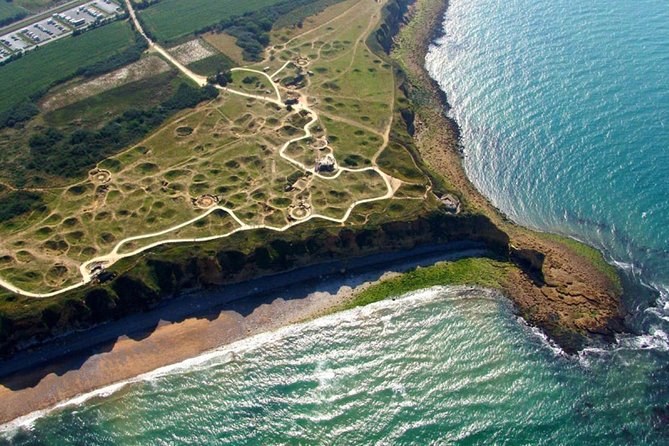
This is why most people sleep in Bayeux. The afternoon departure from Bayeux runs five hours, collects you from selected hotels and has you back around 6pm, so your morning stays free. It stops at Omaha Beach, Pointe du Hoc and the Normandy American Cemetery. The nine-hour day from Place du Québec adds Utah Beach and Sainte-Mère-Église. The beaches and the cemetery are free to enter, so your fare buys the driving and the guide.
Not sure which length suits you? The guide to half day or full day settles it, and Normandy D-Day tours sets every departure side by side, a private sidecar ride included. All of them are excursions in Normandy that start here.
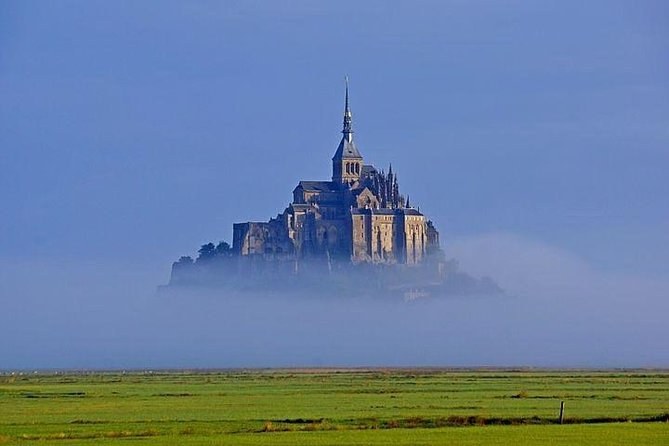
Do not bolt the abbey onto a beaches day. The full day from Bayeux with the abbey included takes seven hours and meets at Place du Québec. You get five hours on the island, two of them inside the abbey, and lunch is yours to buy. The Mont-Saint-Michel page has the tides.
Build your day from the opening hours.
Two nights is the comfortable answer: one day for the town, one for the coast. Still weighing a night in Bayeux or a day trip from Paris? That comparison does the arithmetic, and getting to Bayeux by train covers the journey. Normandy Excursions lists every departure with its fare.
From $109 per person
From $165 per person
From $189 per person