Normandy American D-Day Beaches Full Day Tour from Bayeux
Museum entry includedPickup in BayeuxMax 8
From $165 per person
This is the whole decision and almost nobody sets it out. The three eastern sites — Omaha Beach, Pointe du Hoc and the Normandy American Cemetery — sit within about twenty minutes of each other. Utah Beach and Sainte-Mère-Église are a further half hour west and inland. A half day does the cluster. A full day adds the outliers.
| Half day | Full day | |
|---|---|---|
| Length | 5 hours | 9 hours |
| Omaha Beach | Yes | Yes |
| Pointe du Hoc | Yes | Yes |
| Normandy American Cemetery | Yes, with the visitor centre | Yes |
| Utah Beach | No | Yes |
| Utah Beach Museum | No | Yes, admission included |
| Sainte-Mère-Église | No | Yes |
| Time driving | About 1 hour | About 3 h 30 m |
| Typical fare | $109 per person | $165 per person |
| Refund window | Six days | Twenty-four hours |
For most first-time visitors, yes, and for one reason that has nothing to do with counting stops. Omaha is where the landing went wrong; Utah is where it went to plan. Seeing only one of them leaves you with half an argument, and the museum on the dunes at Utah is the best explanation of the operation anywhere on the coast.
Against that, four hours is four hours. The extra time is not spread evenly across the day — it is mostly the run west and back, which is why a nine-hour day contains about three and a half hours of driving against roughly one on the afternoon version.
Both lengths give you around an hour at the big three. The difference is that the full day has to keep to it, and the half day has room to drift. Reviewers on the afternoon departure repeatedly use words like unhurried and personalised, which is what three stops in five hours buys.
Four kinds of traveller, and none of them is settling for less. Anyone arriving in Bayeux at lunchtime, because the afternoon departure is built for exactly that. Anyone travelling with young children, because five hours is a manageable day and nine is not. Anyone who has a second day and would rather split the coast in two. And anyone whose morning is already spoken for by the Battle of Normandy museum in town.
Anyone for whom this is the reason they came to France. If you have flown across an ocean to stand on Omaha Beach, the four hours are not the expensive part of the trip. Also anyone with a specific interest — a relative who landed, a unit they have read about, a sector they want to walk — because the longer day has room for a guide to accommodate it.
Worth thinking about separately, because it is where a third of a full day goes and almost every comparison treats it as dead time. On these departures it is not. The sectors only make sense against each other — why Utah went to plan and Omaha did not is a question about geography, and the geography is what you are driving through.
Guides on this coast use those legs deliberately. The hedgerow country inland, the villages that were fought through for weeks after the beaches were taken, the flooded fields behind Utah that the airborne drops were aimed at: none of that is a stop, and all of it is visible from a minibus window with somebody explaining it. A half day has about an hour of that. A full day has three and a half.
Both give it about an hour, and both protect it. This is the stop where guides on this coast are consistently praised for not hurrying people, and it is the one travellers write about afterwards. The difference is not duration but timing: a full day usually reaches it in the morning before the coaches, and the afternoon departure arrives when it is busier.
If the cemetery is the reason you are coming — a relative, a name on the Walls of the Missing, a unit you have read about — say so when you book. Several operators build extra time in for exactly that, and on a private day the whole running order can be built around it. The private days explain how that works.
There is a third option that is neither of these. One nine-hour departure from Bayeux follows the ground Easy Company covered rather than running the standard beach circuit, taking in the hedgerow country inland that both the others skip. It is the same length as the full day and a completely different day out, and it holds a five-star average across more than a thousand reviews.
Neither. Both stop somewhere you can buy something, and both exclude food from the fare. The only departure on this coast that carries food is the cruise day out of Le Havre, which packs a lunch because its passengers have nowhere else to get one. Food and drink covers what is worth buying when you do stop.
Both cap at eight travellers per booking, which is small for this coast — caps here run up to fifteen. On an exposed clifftop with wind coming off the Channel, the difference between eight and fifteen is whether you can hear the guide at all, and it is worth more than most people expect when they are comparing prices.
Then you want a second day, not a longer one. The bay is 130 kilometres from Bayeux, an hour and three quarters each way, and the abbey deserves five hours on its own. No honest itinerary puts the landing beaches and the abbey in the same day. The Mont-Saint-Michel page has the tides and the ticket.
Then the question changes shape entirely, and the best answer is not two beach days. Take the full day on the American sector on the first, and give the second to either Mont-Saint-Michel or the British and Canadian sectors around Arromanches and Courseulles. Two days of the same coast produces diminishing returns; two days of different Normandy does not.
The other two-day shape worth knowing: a half day on the coast in the afternoon you arrive, and a full day the next morning. That gets you the three eastern sites twice, in two different lights, and it turns a travel day into a useful one. It is also the cheapest version of two days on this coast.
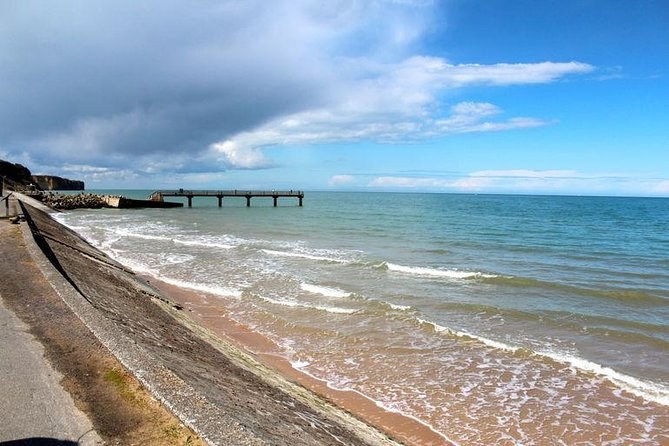
On the coast, barely. The landing beaches are worth seeing at low water, when the sand runs out for hundreds of metres and the scale of the morning becomes obvious, but tides turn twice a day and any guide will time a stop around it.
At Mont-Saint-Michel it matters more. The bay has the biggest tidal range in Europe, and the great spring tides that surround the Mont with water are published years ahead and worth checking if that is the picture you want. To watch the tide arrive, the tourist office advises being on site about two hours before high water — the abbey page has the rest.
September, and it is not close. The ground has dried out from the spring, the wind has not turned yet, and the days are still long enough to walk a clifftop at six in the evening. May is the other candidate and runs it close, with the disadvantage that April and May are when travellers most often write about being colder than they expected.
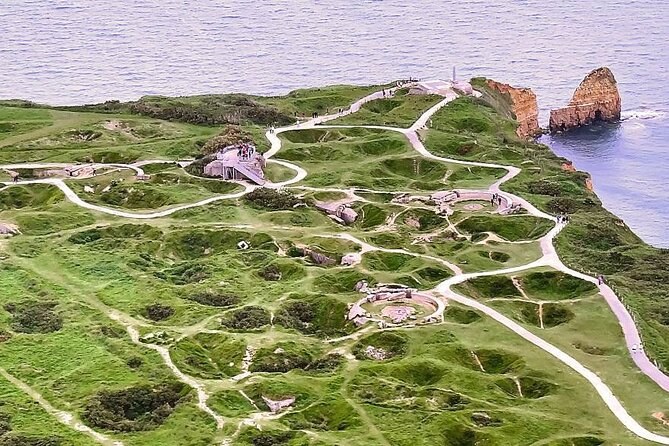
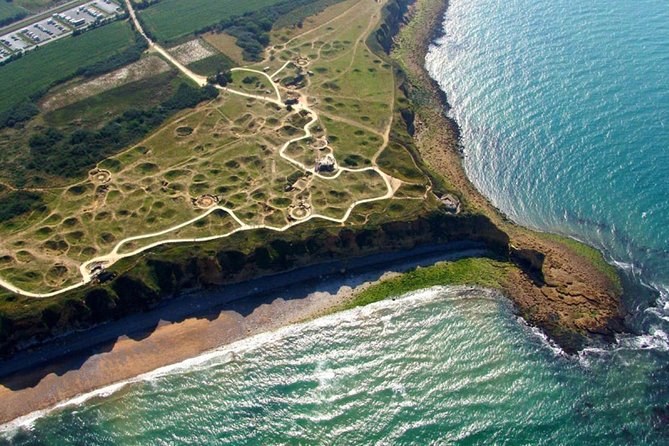
July and August are perfectly walkable and busier. Winter walking on this coast is genuinely fine on a dry day — the terrain is flat, the paths are short, and the crater field at Pointe du Hoc is at its most striking under low cloud.
Two to four weeks from April to September, and earlier if your dates are fixed around the first week of June. Both of these cap at eight travellers and both are flagged as likely to sell out, which on this coast is a reliable signal rather than a sales one — the small-group departures genuinely go first.
Winter is different: a week ahead is usually fine from November to March, and the coast is at its emptiest. The month-by-month guide sets out what is open when, because several museums close for a fortnight in January.
Take the full day unless something specific rules it out. It reaches both American beaches, it includes the one museum admission on this coast that sits inside a fare, and it refunds at twenty-four hours. Take the afternoon if you are short of time, travelling with children, or splitting the coast across two days — it covers the three sites most people came for and it does them slowly.
Normandy tours and tickets print the stop list, the cap and the refund window for both, and the D-Day tours page compares every departure on what it reaches. If you are coming from the capital instead, Normandy Excursions is where the twelve-hour versions are set out.
From $165 per person
From $109 per person