Do You Need a Guide in Normandy? An Honest Answer
Short answer. Sometimes no, and it is worth saying so. Every landing beach, Pointe du Hoc, the Longues-sur-Mer battery and the Normandy American Cemetery are free, open and signposted, and if you have a car you can see them without paying anybody. What a guide buys is the eighty kilometres, an order that works, and the part no plaque gives you. If you have no car, it is not really a choice.
The honest starting point: nothing here charges admission
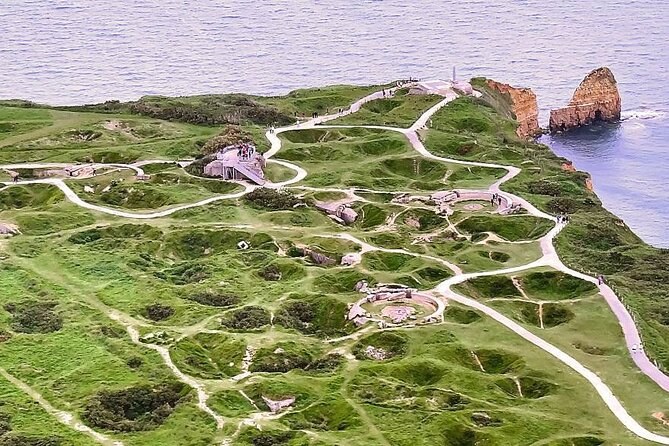
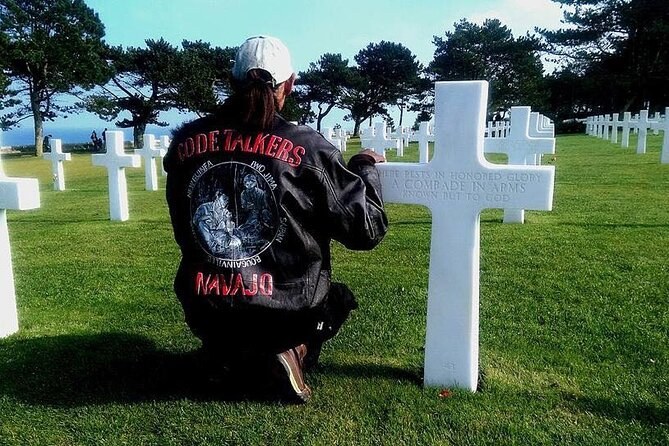
Search for D-Day tickets and you will find pages happy to sell you something. There is nothing to buy. All five sectors are public beaches, Omaha Beach included. Pointe du Hoc is open clifftop with the casemates unlocked. The Longues-sur-Mer battery sits in a field. The Normandy American Cemetery is free to enter and free to park at, 9:00 am – 5:00 pm, last admission 4:30 pm.
So the question is not whether you can afford to see Normandy. It is what you want somebody else to handle.
The three ways to do this coast
| Self-drive | Guided day | Private day | |
|---|---|---|---|
| What you pay | Car hire and fuel | $105–$190 per person | $946–$1,007 per group, or per person |
| Who drives | You | A driver-guide | A driver, with a guide |
| Interpretation | Plaques and your reading | Continuous | Continuous, and yours to steer |
| Route | Yours to work out | Fixed and sensible | Yours |
| Time at each stop | As long as you like | About an hour | As long as you like |
| Best for | Two or more days on the coast | One day, no car | Families, specific interests, mobility needs |
When self-drive is the right answer
Three situations, and in all of them you should keep your money.
- You have two or three days. With time, the pleasure of this coast is stopping where you want. A car and a guidebook is a genuinely good trip.
- You have read about it already. If you know which unit landed where, a guide is telling you things you know. Go and stand on the ground instead.
- You are on a budget. The sites are free. A hire car split between four is cheaper than four seats on anything.
The D514 coast road links the sectors, parking is free almost everywhere, and the memorials are signposted from the main roads. Getting there has the ferry crossings if you are bringing a car from England.
What does a guide actually buy you?
Four things, and only one of them is information.
- The driving. Eighty kilometres of coast road, five stops, and somebody else parking at each one.
- The order. Reaching the cemetery before the coaches, and the beaches when the tide is out, is the difference between two identical itineraries.
- The connective tissue. What happened at Omaha makes sense only against what happened at Utah, and the drive between them is where that gets explained.
- The thing you would not have asked. Every good review of these days names a guide and something they said that was not on a plaque.
What does a self-drive day actually cost?
Worth doing the sum rather than assuming. A small hire car from Bayeux or Caen for a day, plus fuel for around 150 kilometres, plus parking — which is free at almost every memorial on this coast, including the American cemetery. Against that, a shared guided day is about $165 a head.
So for one or two people the guided day is competitive and for four it is not, on price alone. The thing the sum leaves out is the research: somebody has to work out the route, the order, the opening times and where to eat, and that is an evening’s work you either do or pay for. The map page is most of it if you would rather do it yourself.
Can you visit the beaches without a car?
Not usefully on your own. Public transport along the coast is thin and does not connect the memorials in an order that works, and a taxi for a day costs more than a seat on a minibus. This is the case where the decision makes itself: base yourself in Bayeux, take the train from Paris Saint-Lazare, and book a guided day.
Did you know? The one place on this coast where a ticket genuinely changes your day is Mont-Saint-Michel Abbey, at €16 in summer. In July the queue for it eats an hour of a day you have already spent three and a half hours travelling to reach, which is why three departures fold the admission into the fare. The abbey page has the detail.
Is a private day worth the money?
It depends entirely on how many of you there are, and the answer surprises people. Two of the private days here are priced per group rather than per person. A family of five paying once can land close to five small-group seats, and they get a vehicle whose running order bends to them. The private days work the arithmetic through.
What about an audio guide or an app?
They exist and they are fine for the fixed sites. What they cannot do is drive, and driving is the actual problem here. If you have a car and want interpretation without a person, an app plus the visitor centre film at the American cemetery covers most of it.
Do you need a guide for Mont-Saint-Michel?
Less than you need one for the beaches, and more than you would think. The island signposts itself and the abbey has panels, but the village explains almost nothing about why any of it is there. The two-hour guided walk with the abbey ticket included is the cheapest way to fix that, and it starts at the shuttle stop.
What do the best guides on this coast actually do?
Reading several thousand reviews of these departures, the same three things come up and none of them is a fact anybody could not look up. The first is pace: guides who let people stand at the cemetery without moving them on are praised for it, every time. The second is adaptation — a guide who finds out on the drive out that somebody’s grandfather landed at Utah, and reshapes the afternoon around it.
The third is the material they carry. Travellers keep mentioning books of photographs and charts produced at each stop, showing the same view in 1944. That is the thing a plaque cannot do and an app does badly, and it is the clearest single answer to what you are paying for.
Is the free option ever the better one?
Sometimes, and it is worth saying so plainly. If you have read widely about the campaign already, a guide is telling you things you know, and the money is better spent on a second day. If you are travelling with teenagers who will want to run down onto the sand, a car and no schedule is a better afternoon. And if the weather has closed in, being able to change your own plan is worth more than any itinerary.
The visitor centre at the American cemetery is free, and its film and timeline are the best free interpretation on this coast. Start there with a car and a morning, and you will understand more than you expect. Things to do says what each site takes.
What if you are travelling alone?
A shared departure is the obvious answer and it is also the sociable one. These minibuses cap at eight to fifteen and solo travellers pay a single fare with no supplement, which is not true of much in the travel industry. Several of the reviews quoted across this site are from people who came on their own.
The one thing worth knowing is that a private day is not designed for you: the per-group fares only make sense above about five travellers, and paying $946 alone is poor value however good the guide. The private days page sets out where the crossover falls.
The verdict
If you have a car and two days, drive it yourself and spend the money on lunch. If you have one day and no car, book a guided departure — it is not a luxury, it is the only practical way to see five sites in nine hours. If you are four or more, price a private day before you assume it is out of reach.
Normandy guided tours set out what each departure covers and how long it gives you at each stop. If you would rather read about the sites first, things to do says what each one takes, and Normandy Excursions is where the departures are compared side by side.
Frequently asked questions
Do you need a guide for the D-Day beaches?
No, if you have a car and time. Every landing beach, Pointe du Hoc and the American cemetery are free, open and signposted. A guide is worth paying for when you have one day, no car, or want the sites connected to each other.
Can you drive to the D-Day beaches yourself?
Yes. The D514 coast road links the sectors, parking is free at almost every memorial, and the sites are signposted from the main roads. Ouistreham and Cherbourg take the ferry crossings from England if you are bringing your own car.
Is there an entrance fee for Omaha Beach?
None. It is a public beach with a car park. The same is true of Utah, Gold, Juno and Sword, of Pointe du Hoc, and of the Normandy American Cemetery, which does not charge for entry or parking.
What does a guided tour include that self-drive does not?
The driving, a route in an order that works, and continuous interpretation between the stops. On one departure it also includes the Utah Beach Museum admission, which is the only gate money on the coast that sits inside a fare.
Is a private tour better than a small group?
Better for families, for specific interests and for anyone with a mobility need, because the day bends to you. For one or two travellers a small-group seat is almost always cheaper — the private days show where the crossover falls.
Do I need a guide at Mont-Saint-Michel?
Not to get in, but the village explains very little about itself. A two-hour guided walk with the abbey ticket included is the cheapest way to understand what you are walking through, and it starts at the shuttle stop.
What a guide buys that a hire car cannot

2 hour guided tour of Mont Saint Michel, abbey ticket included
Abbey entry includedShuttle bus includedMax 6
From $76 per person
Private Full day American D-Day Guided Tour in Bayeux
Your group onlyMax 8Air-conditioned minibus
From $946 per person